
It's Monday afternoon and you're looking at the promotion advertised on the company jobs board.
You know you should put yourself forward because you're really good at your job.
However, you're about to ignore the opportunity because you're not feeling very confident.

Have you ever talked yourself out of applying for a promotion, even though you know you could do the new job?
Discover a 3-step reflective practice hack to help you overcome this feeling and reach your work goals with confidence.

What is reflective practice?
Here's a scenario for you: Imagine you've given a presentation at work. Your audience didn't seem interested in what you had to say and didn't ask any follow-up questions.

You could simply move on and hope the next presentation goes better.
Or, you could think about:
What went well?
What didn't go well?
What can I do differently next time?
This second approach is called "reflective practice" — the habit of thinking in detail about your experiences so you can learn how to improve things for the next time you carry out that task. 
How do I get started?
The popular "What? So what? Now what?" model of reflective practice will help you turn your thoughts into action.
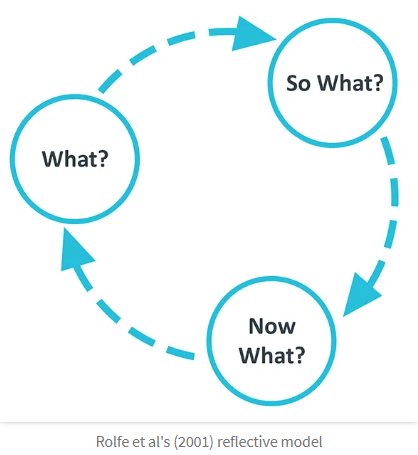
Think of a recent experience you had at work. Examine your experience using each step of the model:
What? What exactly happened in your situation (facts, feelings)?
So what? What was good or bad about it (and why)?
Now what? What do you want to happen next time?

Let's use the presentation scenario above. Here are some example answers for each stage.
What?
"I gave a presentation to my team about a new project. I was really nervous and spoke too fast. Nobody asked any questions afterwards, so I don't know if they understood everything."
So what?
"I said what I needed to, but speaking fast might've made it harder for people to pay attention. It could mean my presentations need to be more interactive."
Now what?
"Before next time, I'll practice speaking slower. I'll hook the audience early on and ask questions throughout to check they understand."
How do I turn reflective practice into professional development?
The first thing to do is identify your end game. Think of a career goal you would like to achieve, like becoming a manager or influencing the use of AI at the company.
Then find someone who already does this as a job. Imagining this person as a ‘future you’ can really help you think up action steps.

Let's return to our presentation scenario above. Say you want to become someone who delivers presentations to important clients. Your action points would be:
Do ✅
Practice stronger opening hooks to grab people's attention.
Practice speaking more slowly.
Think up questions to ask the audience so you can see if they have understood what you're saying.
Don't ❌
Focus on what went wrong before. That's in the past now and can't be changed.
Forget to smile! If you find your topic interesting, your audience will too.

Remember!
Once you've tried out your new actions, reflect on whether they changed your situation in the way you wanted them to.
If they did — well done! You should do more of this to keep building your confidence.
If not, work through the 3-step model again and find something else to try doing differently.
Quiz

Kai would like to become a team leader one day. Recently, his manager asked him to organize a team meeting for the first time, but it didn't go as planned.
Some of the team arrived without the information they needed, the discussion went off track, and everyone ran out of time to make an important decision.
You encourage Kai to use the "What? So what? Now what?" model. After reflecting, Kai tells you:
A. "I organized the meeting and forgot to send the agenda beforehand."
B. "Several team members seemed unprepared and the meeting ran over time."
C. "Not sending the agenda probably made it harder for people to contribute useful ideas."
D. "Next time, I'll send the agenda two days before the meeting and check one day before that the team has read it."
Quiz
Which answer is the best example of the "Now what?" step?
Take Action

Your feedback matters to us.
This Byte helped me better understand the topic.