
 In today’s hyperconnected world, communication across the globe is easier than ever. We can exchange words at the touch of a button.
However, communication isn’t just about words. Tone, slang, facial expressions, gestures, and even silence shape provide depth of meaning to our communication — and these are harder to translate.
That’s why being a strong intercultural communicator goes beyond vocabulary.
When you understand how nonverbal cues differ across cultures, you’re far more likely to avoid misunderstandings and build real connection.
Beyond Words

This is Sara. She's a student who traveled to France to participate in a language immersion program.
On one of her days off, she decides to go into the city to explore. This is the perfect opportunity to practice some of her new language skills.
 She decides to start her day with a stop at the bakery. She's nervous but ready to use all of her prepared phrases.
When it's her turn, she walks up to the counter and confidently says, "Je voudrais un croissant, s’il vous plait." (I would like a croissant, please.)
 The shop owner scowls at Sara and abruptly answers back with, "Bonjour!"
Sara is confused and repeats her order, thinking that the owner didn't understand her. After another dirty look, the woman hands her a croissant.
She looks around for a place to sit, choosing a seat next to a gentleman sipping his coffee. She makes eye contact and smiles brightly.
 He looks at her, slightly confused.
Sara takes his eye contact as an invitation to talk and loudly strikes up a conversation about how much she loves croissants, that she’s studying abroad, and that she’s spending the day in the city.
She is met with a cold, confused look as the gentleman reluctantly acknowledges her.

Sara didn't realize that she encountered some nuances of French non-verbal communication:
You must greet the shop owner with a "bonjour" when entering the shop.
People are expected to respect strangers' peace by not engaging with fellow customers.
Finally, in France, the volume of your voice should remain low so as not disturb other people.
What Is Non-verbal Communication?

Were you taught to look people in the eye when they're talking to you, or to look down when talking to superiors?

Were you told that a firm handshake in professional settings shows confidence?

Were you taught to wait for a senior person in the room to speak before providing input?

When you greet your friends, do you hug, kiss, or shake hands?
The choices you make in these scenarios are examples of your learned non-verbal communication rules.
Both verbal and non-verbal communication act as cultural reinforcers. They're a way of creating meaning and reinforcing belonging.
However, non-verbal communication across cultures can be more difficult to understand. This can lead to miscommunication and even conflict, especially for outsiders.
What Does a Queue Say About Your Culture?
 One of the most interesting observations of non-verbal cultural expression happens when people stand in line (aka "queue" in places that use UK English).
 Next time you're in a store, take note of how the line moves and how people behave while waiting in a line:
How do they enter the line?
How much space is between each person?
How does everyone behave when a new lane opens?
Believe it or not, there's a lot of non-verbal communication going on in a store queue. Pay attention to personal space — the space between people.
How do we navigate space and time?
Personal space is an example of a non-verbal communication rule that determines how people interact with each other in public.
Closeness, or a lack of it, is also a culturally informed behavior. For example:

Physical closeness between people of the same gender is common among friends or even acquaintances in:
Turkey
Iran
Thailand
Bahrain
Korea
Whereas same-gendered touch isn't as common in:
the US
Canada
Germany
The UK
In the United States, greetings are often met with a hug, especially among friends, but personal space is still valued in public settings.
In Japan, people are more comfortable in close proximity to each other in public settings, yet greetings are done at a distance with a bow.
Expressions and Body Language
In some cultures spoken language, is relied on far less than non-verbal cues. These cultures are called "high-context":

Korea

Japan

China
Thailand
In these countries, people are expected to "read the room" and use non-verbal cues to determine what isn't being said.
For Northern Europeans and North Americans, this can be difficult because their cultures are considered "low-context".
In these cultures, verbal communication is more dominant.
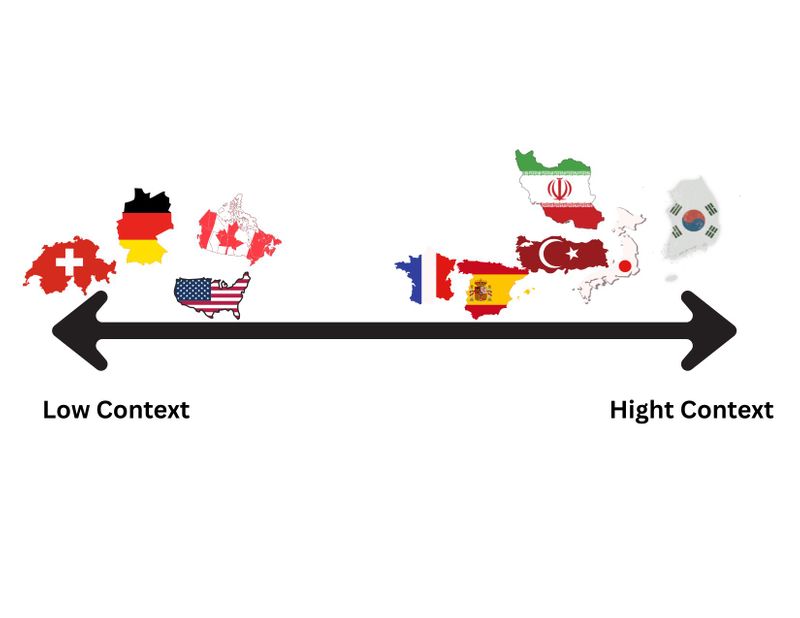 Low-context cultures also tend to be more outwardly expressive with their body language and gestures.
In high-context cultures, gestures and body language can be more reserved. It's assumed that people are paying attention to subtle non-verbal cues because there's an expectation of shared understanding.
It's important to note that this is a spectrum. Each culture doesn't sit neatly on one side or another.
 In many cultures around the world, it's extremely rude to hand things to people with your left hand. As a general rule, if you're unsure, use your right to pass things to others.
Quiz
You're a female walking with a colleague in Thailand. She reaches down and grabs your hand as you walk and talk. This...
A Minefield of Gestures
While the use of gestures is seen by some as a form of body language, it deserves extra focus because using or misinterpreting the wrong gesture can cause deep misunderstanding or even offense.
Examples of gestures that mean different things in different places:

In some places, the thumbs-up gesture is a sign of agreement, like in the USA. However, in Iran, it's a vulgar insult.

Touching your thumb to your index finger (making an "O") means "OK" in the USA, but in Germany or France, it's an insult, meaning "you're a loser."

Pointing is a common way of showing people what you're talking about in some places. However, in some places, it's considered rude.

The beckoning finger (palm up, with your index finger moving back and forth) means "come here" in some places, but in Korea, it's what you do when calling a dog.
Learning the meaning of various gestures is the best way to ensure you don't accidentally cause offense when practising nonverbal communication across cultures.
On the flip side, using gestures appropriately can be a bridge builder and help you build relationships across cultures. Here's a video that shows what certain gestures can mean in different places:
When Misunderstandings Happen

Unfortunately, a comprehensive guidebook to mastering the art of cross-cultural non-verbal communication hasn't been created.
Instead, non-verbal communication across cultures happens through messy interactions that lead to learning and growth. This means you need to gett out there and:
Observe what others are doing and how they interact with each other.
Reflect on what you're doing and how it is being received.
Adjust when you know the right thing to do or if you make a mistake.
Finally, when you find yourself feeling irritated during an interaction with someone with different cultural communication styles, get curious.
Quiz: How Rude?
You decide to take a trip to Korea to experience the food, music, history and culture. You’ve spent months preparing, learning a few basic phrases, researching local customs, and planning all the sights you want to see.
After a long flight, you step off the plane and are immediately met with a rush of people. Everything feels unfamiliar and overwhelming. You make your way to the baggage claim, trying to navigate through the crowd.
 Suddenly, an older woman comes up behind you and nudges past to grab her bag, without saying anything.
Your first instinct is to feel upset. Who does she think she is, pushing past you without even saying “excuse me”?
But pause for a moment — what is the most likely reason for her behavior in this context?
A. She's rude and entitled. She doesn't know how to act politely in public spaces.
B. She doesn't like foreigners and wants them to leave her country.
C. She's in a rush because she has some place to be.
D. She's an elder and expects you to understand that her age gives her priority in public spaces.
Quiz
What's the most likely reason for the older women's behavior?
Take Action

Non-verbal communication across cultures is a dense topic. There are a few things you can do to better understand it:
Your feedback matters to us.
This Byte helped me better understand the topic.