Ever hear an interview question and suddenly forget every experience you’ve ever had?
Questions like, “Describe a time you had to learn something quickly?” can feel stressful because employers expect a real example fast.
The good news? Interviewers are not looking for the perfect answer. They want proof that you can adapt, learn quickly, and handle challenges without panicking.
What do employers actually want?
This question isn't really about how smart you are.
Interviewers want to know if you can:
adapt quickly
solve problems
learn on your own
stay calm under pressure
These skills matter in fast-moving jobs. A strong answer shows that you can handle new challenges without falling apart.
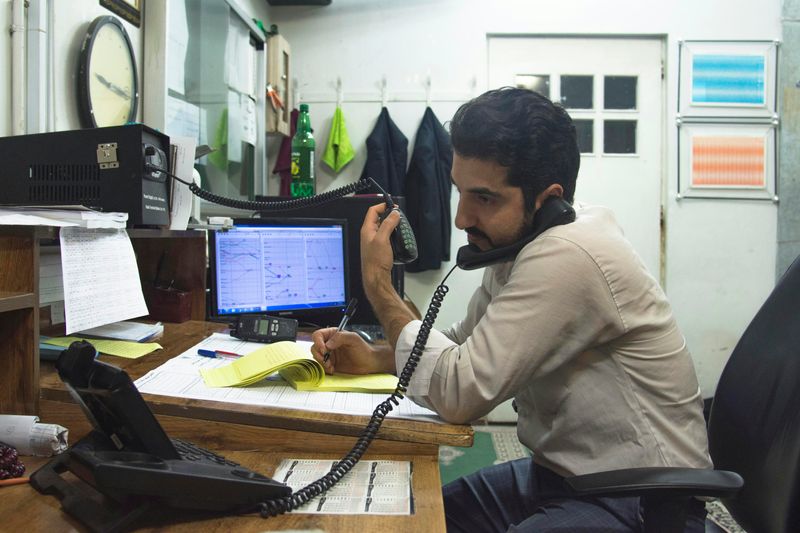 Photo by Javad Esmaeili on Unsplash
How should I structure my answer?
A simple structure can keep your answer focused. Try using the LIFT method:
Learn → What did you need to learn?
Initiative → What did you do to learn fast?
Follow-through → How did you keep improving?
Takeaway → What happened in the end?
Focus most on the actions you took. That is usually what interviewers care about most.
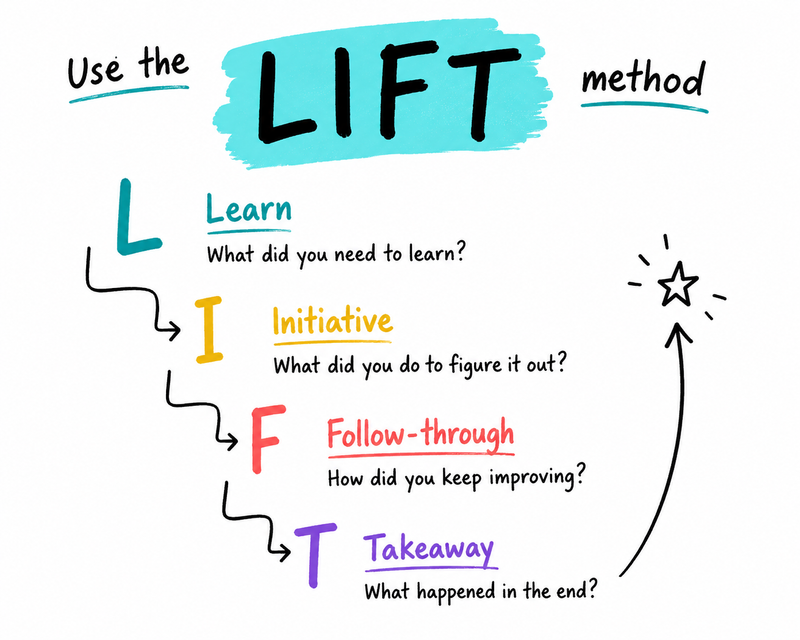 Image created by author using Canva
What makes an answer strong?
Strong answers focus on your actions, not just the outcome.
Instead of saying:
I learned the system quickly.
Explain HOW you learned it.
I watched training videos after work, practiced entering sample orders, asked questions, and took notes until I felt confident using the system.
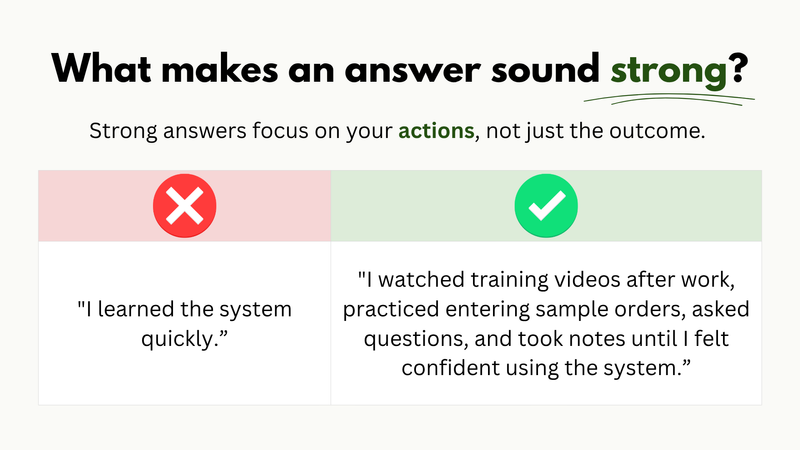 Image created by author using Canva
You could talk about how you:
watched tutorials
practiced after work
asked questions
took notes
tested different approaches
This shows initiative and problem-solving skills.

Knowledge Check 🔍
Taylor had to learn a new customer chat platform two days before a busy sales event. Which answer would probably impress an interviewer the MOST?
A.
I learned the platform quickly and was able to help customers during the event. I usually pick up new tools fast, so I was not too worried.
B.
I watched tutorials during my breaks, tested the platform before the event, and created a cheat sheet so I could respond to customers faster.
C.
My team worked together to figure out the new platform. We helped each other when we got stuck, and the event went smoothly.
D.
The platform was different from what I was used to, but I stayed patient and eventually got the hang of it after using it for a while.
Quiz
Choose the strongest interview answer from the examples above:
What if I don’t have a big example?
Your story doesn't need to be dramatic.
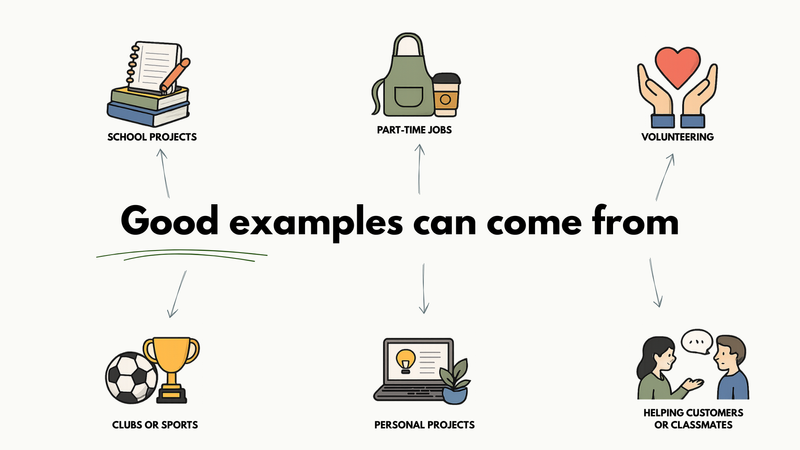 Image created by author using Canva
Good examples can come from:
school projects
part-time jobs
volunteering
clubs or sports
personal projects
helping customers or classmates
Interviewers usually care more about your attitude and problem-solving skills than having a huge accomplishment.
A small story with clear actions is often stronger than a big story with no details.
Knowledge Check 🔍
Select all answers that could be strong examples for this interview question.
A.
During a volunteer event, I was asked to coordinate the schedule for a group of participants. I had never managed an event timeline before, so I quickly learned how to organize tasks, communicate updates, and adjust plans when things changed.
B.
For a school project, my group needed to use presentation software that I had never used before. I watched tutorials, practiced on my own, and helped create the final presentation.
C.
I really enjoyed working at a summer festival and had a lot of fun meeting new people throughout the event.
D.
At my part-time job, the store switched to a new checkout system. I learned the new process by reviewing training materials, practicing transactions, and asking questions when I got stuck.
Quiz
Choose all of the strongest interview answers from the examples above:
What mistakes should I avoid?
A lot of interview answers sound weak for similar reasons.
Avoid:
giving too much background information
being vague about your actions
talking more about other people than yourself
ending the story without a result
Try to keep your answer focused on:
what happened
what you did
what happened afterward
Clear and specific answers are easier for interviewers to remember.
 Knowledge Check 🔍
Which answer would sound the strongest in an interview?
A. Explain everything that happened from the beginning.
B. Talk about how your manager handled the most difficult parts.
C. Explain the situation, focusing on the actions you took, and end with the result.
D. Talk about how stressful the situation was.
Quiz
Choose the strongest answer.
Take Action
Try this before your next interview!
Before your next interview, prepare one or two examples using the LIFT method.
Focus on:
what you needed to learn
the actions you took
and what happened afterward
The more specific your example is, the more confident you’ll sound.
Quick practice checklist:
Your feedback matters to us.
This Byte helped me better understand the topic.