
Have you ever wondered why there are millions of insects on Earth, but only a handful of predators like lions and tigers?
The answer lies in understanding the rule of 10% in biology. It explains how energy moves through different levels of an energy pyramid.
These levels are also called trophic levels. Each one is made up of different groups of living organisms that gain energy from the level below them.
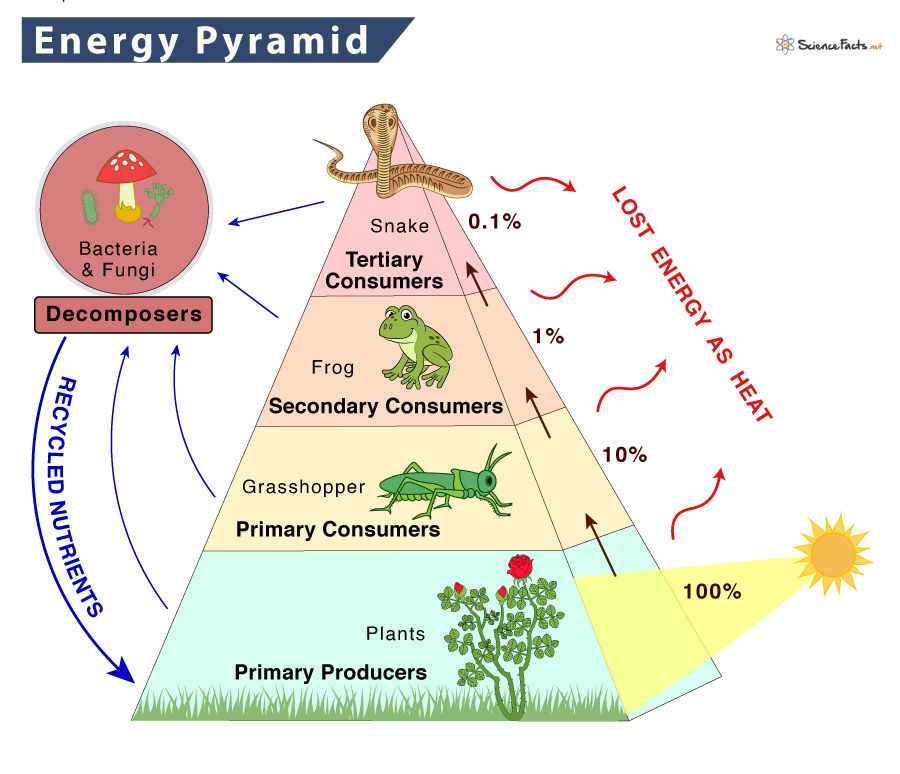 Image courtesy of ScienceFacts. To hear an audio description of the image, click play on the audio player below.
Level 1: From the Sun to Producers (Plants)
The 10% rule begins when energy from the sun reaches primary producers like plants and algae.
Think of these plants and algae as the "solar panels" of nature. They capture sunlight energy and convert it into carbohydrates and oxygen through a process called photosynthesis.

This first step makes up 100% of the energy that enters the energy pyramid. Plants use most of this energy to carry out life processes such as growth, repair, and reproduction. A lot of energy is eventually lost as waste and heat. Only about 10% of the energy stored in plants is available to the animals that eat them.
 Imagine a blade of grass captures 1,000 units of energy or 1000 joules of energyfrom the sun.
It uses 900 joules for its own growth, repair, reproduction, and for other life processes. This leaves 100 joules of energy stored in the blade of grass for an animal to eat.

In other words, 90% of this energy is used by the plant, and only the remaining 10% is available for the animals that eat the plants.
Quiz
How does a plant use the majority of the solar energy it absorbs?
Level 2: From Producers to Primary Consumers (Herbivores)
A primary consumer is an animal that eats producers, such as plants and algae, to obtain energy. These animals are also known as herbivores.
Let's see how the rule of 10% works here.
 Meet Merry the Grasshopper, our star primary consumer and our first plant-eating animal in our food chain!

Merry munches on a blade of grass that contains 1000 joules of stored energy. Like all living things, Merry uses most of that energy to move, to grow, to dodge predators or to stay alive... and last but not least some energy is converted and lost as poop!
Finally, we're only left with about 100 joules of energy stored in Merry's body. This means that if a passing frog were to eat Merry tomorrow, only 100 joules of energy would transfer over.
Level 3: From Primary to Secondary Consumers
A secondary consumer is an animal that eats primary consumers to gain energy. These animals are often carnivores (they eat meat) or omnivores (they eat both plants and meat).
As energy moves from a primary consumer to a secondary consumer, the same Rule of 10% applies. Let's see what this looks like!
 Meet Señor Frogamore, our hopping superhero and secondary consumer!
Señor Frogamore spots Merry the Grasshopper and quickly snaps her up for lunch. Remember, Merry only stored 100 joules of energy in her body.

Like all living things, Señor Frogamore uses most of that energy for his daily needs.
He catches insects, leaps from lily pad to lily pad, croaks at his neighbours, and poops.
At the end of it all, only about 10 joules of energy is stored in Señor Frogamore's body. This means that if a snake were to eat him tomorrow, it would only receive the 10 joules of energy stored in his body.
From 1000 joules of energy in the blade of grass to just 10 joules in a frog — 99% of the original solar energy is gone. Nature’s energy tax is no joke!
Quiz
Señorr Frogamore needs 100 joules to survive daily. What should he do?
Level 4: From Secondary to Tertiary Consumers
A tertiary consumer is an animal that gains energy by eating secondary consumers. These animals are often top predators, or apex predators, within their ecosystem.
As we know, when energy continues to move up the energy pyramid, only about 10% of the energy from one trophic level is passed on to the next.

Meet Baroness Von Slither, a snake who is also our dramatic tertiary consumer!
As Señor Frogamore is basking in the sun, Baroness Von Slither strikes and swallows Señor Frogamore whole. Remember, Señor Frogamore only stored 10 joules of energy in his body.

Baroness Von Slither uses most of that energy for her daily needs. She slithers through the grass, sheds her skin, digests her food, stays alive... and poops.
At the end of it all, only about 1 joule of energy is left stored in Baroness Von Slither's body.
From 1,000 calories in a blade of grass to 1 calorie in a snake — yes, nature’s energy tax is absolutely savage!
Quiz
Baroness Von Slither the snake gets snatched up by a Captain Talon, a hawk. How many calories will Captain Talon actually get after the 10% rule is applied?
Energy Loss: Waste & Decomposers
 What happens to the energy loss through waste?
Well, we now know that all living things — from Merry the Grasshopper to Señor Frogamore to Baroness Von Slither the snake — all share some similar life processes. One of the processes common to all living things is to poop!
That poop gets to be the food for a special group of organisms called decomposers. They include many bacteria and fungi. They feed off the leftovers of living things.
The 10% rule hits them too — they use much of that energy to wiggle, grow, and stay alive, and the rest escapes as heat.
Then the remains of what decomposers leave behind become perfect nutrient-rich fertilizer. That fertilizer is used by plants for photosynthesis, and the cycle continues!
The Energy Tax Math
Only 10% of energy moves up to the next level of a food chain, and 90% of energy is completely lost at every single step of the trophic level. Energy doesn't vanish from existence: it just exits the living food chain.
Next time you look at a food chain pyramid, remember that the animals at the top have to hunt constantly because 99.9% of the sun's original energy vanishes before it even reaches them. Use this cheat sheet for review:
Trophic Level 1: grass captures 1,000 calories of pure solar power
Trophic Level 2: grasshopper keeps only 100 calories
Trophic Level 3: frog keeps only 10 calories
Trophic Level 4: snake keeps only 1 calorie
Trophic Level 5: hawk keeps a microscopic 0.1 calories
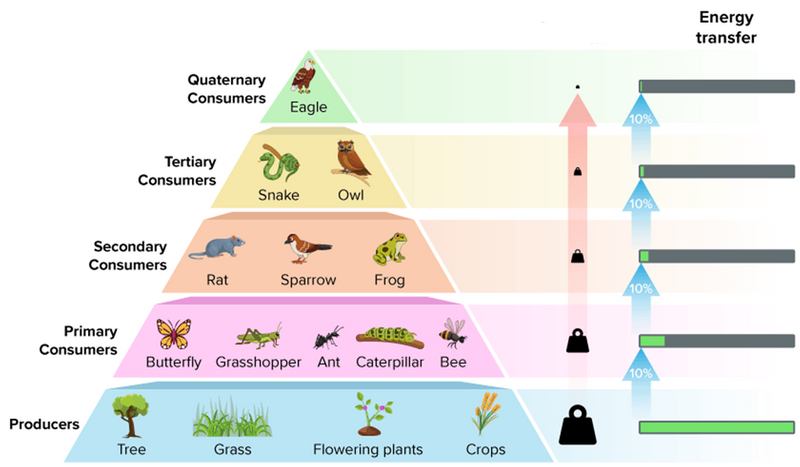 Image courtesy of Wikimedia Commons
Take Action
Now you know why there are millions of insects on Earth, but only a handful of predators like lions and tigers.
With a great percentage of energy available to the lower tropic levels, ecosystems can support large numbers of producers and primary consumers.
But with 10% energy loss at every stage of the trophic level, we have fewer secondary and far fewer tertiary consumers, and so on.
Want to learn more about how energy moves through ecosystems?
Your feedback matters to us.
This Byte helped me better understand the topic.